




Fallopian Tube Problems
Fallopian tube problems are one of the commonest causes of female infertility and one of the quietest — damaged tubes usually produce no symptoms at all, so the first sign is often simply that pregnancy is not happening.
The tubes are not passive pipes. Understanding what they actually do explains why some damage can be repaired and why other damage is better bypassed than fixed.
On this page
- What the fallopian tubes do
- What causes tubal damage
- Why there are usually no symptoms
- Hydrosalpinx
- How the tubes are tested
- Tubal surgery, and when it helps
- IVF for tubal factor infertility
- Ectopic pregnancy risk
- Reducing the risk
- What happens at a first consultation
- Questions patients ask
What the fallopian tubes do
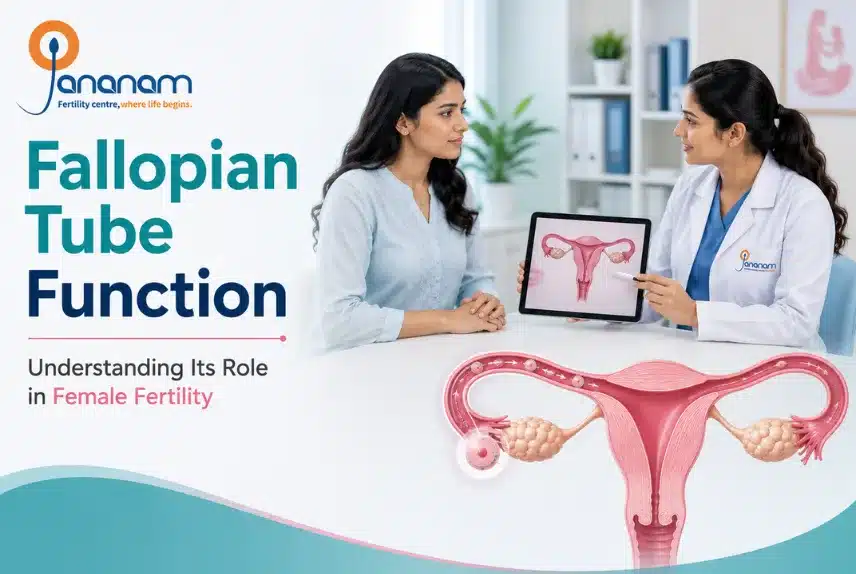
Each tube runs from the top corner of the uterus towards an ovary and ends in a fringe of finger-like projections called fimbriae. At ovulation the fimbriae sweep over the ovary and collect the released egg.
Inside, the tube is lined with microscopic hairs and surrounded by muscle. Fertilisation normally happens in the outer third of the tube. The lining then nourishes the early embryo and moves it into the uterus over five or six days.
Fallopian tube problems arise when either of those functions is lost. So a tube must be open, and it must also work. A tube that is technically patent but has lost its lining and its fimbriae cannot do the job. That distinction sits underneath every decision about surgery versus IVF.
What causes fallopian tube problems
Infection is the largest single cause. Pelvic inflammatory disease, usually from chlamydia or gonorrhoea, and genital tuberculosis — still an important cause in India — scar the delicate inner lining. The damage is frequently silent and can follow a single episode.
Pelvic surgery, a ruptured appendix, a previous ectopic pregnancy, a termination complicated by infection, and endometriosis can all create adhesions that kink or block a tube from the outside.
Sterilisation is a deliberate cause. Congenital absence or malformation of a tube is rare. In a proportion of women no cause is ever identified.
Genital tuberculosis deserves a separate mention because it is frequently missed. It can affect the tubes and the lining of the uterus without ever causing a cough or a fever, and it is sometimes found only at laparoscopy or on an endometrial sample. If you have a family history of tuberculosis, or were treated for it as a child, mention it.
Blockage is also described by site: at the uterine end, in the middle, or at the fimbrial end. The site largely determines what, if anything, can be repaired.
Why there are usually no symptoms
Most women with tubal damage feel entirely well. Where symptoms occur they are non-specific — pelvic pain, pain with sex, unusual discharge, or heavier and more painful periods.
Acute pelvic inflammatory disease does cause symptoms: fever, pain, discharge. Treating it promptly protects the tubes far more effectively than anything that can be done later. The NHS page on pelvic inflammatory disease lists the warning signs worth acting on.
Hydrosalpinx
When a tube is blocked at its outer end it can fill with fluid and swell. That is a hydrosalpinx, and it is often visible on ultrasound as a sausage-shaped structure beside the uterus.
A hydrosalpinx is more than a blocked tube. The fluid can leak back into the uterine cavity and appears to reduce implantation, which is why IVF results are poorer when one is left in place.
For that reason removal of the affected tube — or clipping it where removal would be difficult — is generally advised before IVF. It is one of the clearer recommendations in the management of tubal disease.
How fallopian tube problems are diagnosed
A routine pelvic scan does not show whether the tubes are open. It shows a large hydrosalpinx, and it shows the ovaries and uterus, but patency needs a specific test.
A hysterosalpingogram uses X-ray and contrast injected through the cervix to outline the cavity and show whether dye spills from the ends of the tubes. HyCoSy or HyFoSy does the same with ultrasound and foam or saline, without radiation.
Both can be uncomfortable. Take simple pain relief an hour beforehand, expect cramping for a few hours afterwards, and arrange to be driven home if you can.
Laparoscopy with dye is the reference standard, because it also shows the outside of the tubes, adhesions and endometriosis. It needs anaesthesia, so it is reserved for women in whom surgery may follow. Hysteroscopy is usually combined with it to inspect the cavity.
One caveat is worth knowing. A tube that does not fill on a hysterosalpingogram is not necessarily blocked; spasm at the uterine end produces false readings, and a repeat or a different test sometimes shows a normal tube.
Tubal surgery, and when it helps
Surgery has a real role in a narrow set of situations. Reversal of sterilisation in a younger woman with otherwise normal fertility and adequate healthy tube length can restore natural conception. Dividing adhesions around an otherwise healthy tube can help.
Opening a blocked distal tube works when the damage is mild and the inner lining is preserved. Where the tube is thick-walled, its lining destroyed and its fimbriae gone, surgery restores patency but not function, and the main consequence is a raised risk of ectopic pregnancy.
Age is the deciding variable. Surgery offers a chance of natural conception but takes months to declare itself. For a woman of 38 with damaged tubes, that delay usually costs more than the operation gains.
IVF for tubal factor infertility
IVF was developed for exactly this situation. Eggs are collected directly from the ovaries, fertilised in the laboratory, and an embryo is placed in the uterus. The tubes are not involved at any stage.
It is the appropriate first treatment when both tubes are blocked, when the damage is severe, when the woman is older, or when a sperm problem is present as well. Both partners are evaluated before that plan is made.
Where only one tube is affected and the other is healthy, natural conception stays possible, and a defined period of trying with ovulation tracking is reasonable before moving on.
Ectopic pregnancy risk
Tubal damage is the main risk factor for ectopic pregnancy, in which the embryo implants in the tube instead of the uterus. It is a medical emergency, not a wait-and-see problem.
If you conceive after tubal surgery, ask for an early scan at around six weeks rather than waiting. Sharp one-sided pain, shoulder-tip pain, faintness or bleeding in early pregnancy needs same-day assessment. The RCOG leaflet on ectopic pregnancy explains what to expect.
Reducing the risk
Not all fallopian tube problems can be prevented, but some can. Prompt treatment of pelvic infection, treatment of partners, barrier protection against sexually transmitted infection, and early investigation of genital tuberculosis in endemic settings all help preserve tubal function.
If you have had pelvic infection, an ectopic pregnancy or pelvic surgery, say so at your first fertility appointment. It changes which test is done first.
What happens at a first consultation
Assessment covers both partners from the start: history, examination, pelvic scan, ovarian reserve blood tests and a semen analysis, with the tubal test chosen to suit your history rather than applied by default.
Treatment add-ons are offered selectively here, not routinely. The plan is then discussed with its reasoning and its alternatives — including doing nothing for now — before anything is booked.
Questions patients ask
Can a blocked tube be opened with medication? No. Antibiotics treat active infection but cannot reverse scarring. Flushing during a hysterosalpingogram may clear debris or spasm, and there is modest evidence of a short-lived rise in conception afterwards, but it will not open a truly scarred tube.
Can I conceive with one tube? Yes, provided that tube is healthy and you are ovulating.
Will removing a tube reduce my egg numbers? Careful removal preserves the ovarian blood supply. Raise it specifically if a hydrosalpinx is being removed.
Do fallopian tube problems cause miscarriage? Not directly. Tubal damage affects whether the embryo reaches the uterus, not whether an established pregnancy continues.
How long should we wait before testing? Twelve months of trying, or six months if you are over 35 — and sooner if you have any history that puts the tubes at risk.
Is a hysterosalpingogram safe if I might already be pregnant? No, which is why it is timed to the first half of the cycle, after bleeding has stopped and before ovulation. Tell the team if there is any chance you have conceived that month.

Written and medically reviewed by Dr. Vani Sundarapandian, MD, DGO, FRCOG (UK) — founder and Medical Director, Jananam Fertility Centre, Chennai.


