




Donor Egg IVF
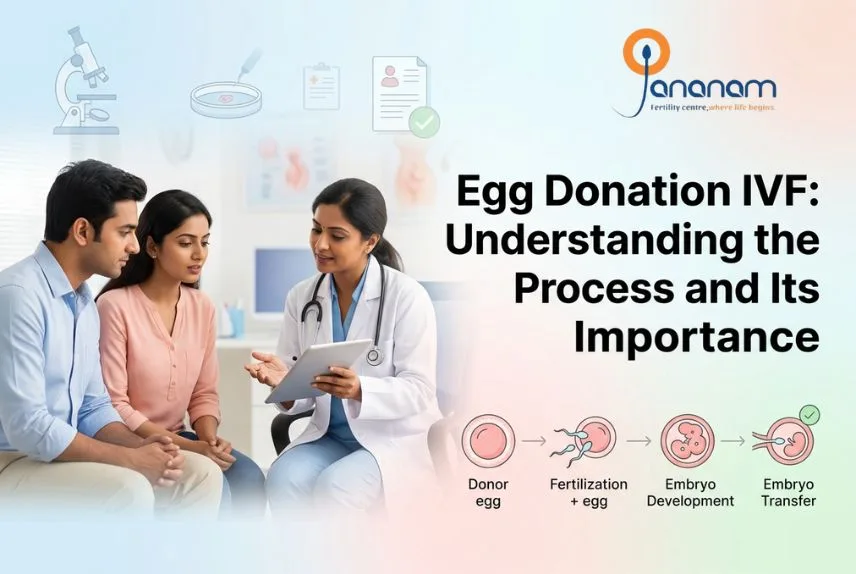
Donor egg IVF is treatment in which eggs from another woman are fertilised with your partner’s sperm, or with donor sperm, and the resulting embryo is transferred to your uterus so that you carry and give birth to the child.
It is the option people arrive at most reluctantly and understand least well. In India it is also tightly regulated, and the rules about who may donate, how often, and on what terms are the part patients are most often told nothing about.
On this page
- What donor egg IVF is
- When it is considered
- The legal framework in India
- Who may donate, and how often
- Anonymity, records and parental rights
- Compensation and insurance
- How the treatment works
- Pregnancy and obstetric considerations
- The part that is not medical
- Alternatives worth weighing first
- Questions patients ask
What donor egg IVF is
The donor takes stimulation medication and has her eggs collected. Those eggs are fertilised in the laboratory, usually by ICSI, and one embryo is transferred into your uterus after your lining has been prepared with oestrogen and progesterone.
The child is not genetically related to you, and is genetically related to your partner if his sperm is used. You are, medically and legally, the mother: you carry the pregnancy, give birth, and are named on the birth certificate.
Spare embryos can be cryopreserved for later attempts, and the rules that govern embryo freezing and storage apply to them in the same way.
When it is considered
The common reasons are premature ovarian insufficiency, ovaries removed or damaged by surgery, chemotherapy or radiotherapy, and very low ovarian reserve shown by ovarian reserve testing and a low AMH.
It is also raised after repeated cycles producing no usable embryos, after recurrent miscarriage linked to egg-related chromosomal problems, where a serious genetic condition would otherwise be transmitted, and with advanced maternal age.
The honest framing is that egg quality declines with age and cannot be restored. Where own-egg cycles have repeatedly produced nothing transferable, continuing them is often the more painful choice, not the safer one.
The legal framework in India
Donor egg IVF in India is governed by the Assisted Reproductive Technology (Regulation) Act 2021, alongside the Surrogacy (Regulation) Act 2021. Both clinics and gamete banks must be registered with the national registry, and treatment outside a registered unit is not lawful.
Under the Act a clinic may not obtain donor eggs directly. Donors are screened and enrolled by a registered ART bank, and the bank supplies the clinic. The Act also provides that a bank shall not supply the gametes of a single donor to more than one commissioning couple.
Eligibility rules apply to recipients too. The Act sets age limits for a commissioning couple — broadly 21 to 50 years for the woman and 21 to 55 for the man — and requires written informed consent from both before treatment begins.
What follows describes the framework as written; it is not legal advice. The rules and forms are amended from time to time, so confirm the current requirements directly with the clinic before you commit to anything.
Who may donate, and how often
The Act sets out that an egg donor must be an ever-married woman aged between 23 and 35 who has at least one living child of her own aged three years or older.
It further provides that a woman may donate her eggs only once in her lifetime, and that no more than seven eggs may be retrieved from her. Those two limits exist to protect donors from repeated stimulation and egg collection, and they are the clearest difference between Indian law and many other countries.
Donors are screened for infectious disease and, where indicated, for genetic carrier status. Their written consent is required and may be withdrawn before the eggs are used.
One practical consequence of the once-in-a-lifetime rule is that the pool of eligible donors in India is smaller than in many other systems, and waiting times reflect that. Ask early what the realistic wait is, and ask whether frozen donor eggs are available, since they remove the need to synchronise two cycles.
Anonymity, records and parental rights
Indian law is built around donor anonymity. The identity of the donor is not disclosed to the commissioning couple, and the couple’s identity is not disclosed to her. Records are held by the bank and reported to the national registry.
The donor relinquishes all parental rights over any child conceived from her eggs. The child born through donor egg IVF is deemed the biological child of the commissioning couple, with the same rights as a naturally conceived child.
This differs sharply from countries that have moved to identity-release donation, where a donor-conceived person may obtain identifying information at eighteen. If that difference matters to you, raise it before treatment, not afterwards.
Compensation and insurance
Donation in India is altruistic. The Act prohibits the sale or purchase of gametes, and a donor may not be paid a fee for donating. Advertisements offering payment for eggs are not lawful.
What the Act does require is insurance. The commissioning couple must arrange insurance cover in the donor’s favour, for a defined period, sufficient to cover loss, damage or death arising from the donation. Ask to see how that has been arranged.
How the treatment works
Your cycle is synchronised with the donor’s, or a frozen donor egg or embryo is used so timing is flexible. Your lining is prepared with oestrogen, monitored by scan, and progesterone is added before transfer.
Fertilisation, culture to blastocyst and transfer follow the same sequence as standard IVF. A single embryo is transferred in almost all circumstances, because twin pregnancies carry materially higher obstetric risk and there is no reason to accept it.
Progesterone support continues into early pregnancy. Add-ons are offered selectively here, not routinely: the endometrial receptivity array was used in more than 750 patients at this clinic and is no longer offered.
Pregnancy and obstetric considerations
One finding is consistent enough to plan around. Pregnancies from donated eggs carry a higher reported rate of hypertensive disorders, including pre-eclampsia, than pregnancies from a woman’s own eggs, independently of her age.
The practical consequence is obstetric, not a reason to avoid treatment: antenatal care should be booked with that risk recorded, blood pressure monitored closely, and aspirin prophylaxis discussed according to local obstetric guidance.
Recipient age matters too. Pregnancy after 45, however conceived, carries higher rates of gestational diabetes, hypertension and caesarean birth, and a medical review before treatment is appropriate rather than optional.
The part that is not medical
Most people need time to grieve the genetic link before they can decide about donor eggs. That grief is normal, it is not a sign that the decision is wrong, and rushing past it tends to surface later.
Counselling should be offered to both partners, separately if wanted. The ESHRE guidance on information provision in donation and the ASRM guidance on gamete and embryo donation both set out what patients should be told before consenting.
Whether and how to tell the child is your decision. The research literature broadly favours telling early, in age-appropriate terms, rather than disclosure in adolescence or by accident. Anonymity in law does not remove that question; it only changes what you are able to tell them.
Alternatives worth weighing first
Before moving to donated eggs, it is reasonable to ask whether a different own-egg approach has been tried. Dual stimulation and egg accumulation exist for exactly the low-reserve situation.
Embryo donation, adoption and choosing to stop treatment are all legitimate endpoints. A good consultation names all of them rather than presenting donor egg IVF as the only remaining door.
Questions patients ask
Can we choose the donor? Not by identity. Banks match on physical characteristics, blood group and similar attributes; you will not be shown who she is.
Will the baby resemble us? Possibly, through matching and through your partner’s contribution. There is no guarantee, and expecting one is a poor basis for the decision.
Is donor egg IVF allowed for single people? The Act is restrictive about who may commission treatment. Ask the clinic to explain your specific eligibility in writing.
How many attempts should we plan for? More than one, with any surplus embryos frozen. Planning for a single attempt tends to make the second decision harder, not easier.

Written and medically reviewed by Dr. Vani Sundarapandian, MD, DGO, FRCOG (UK) — founder and Medical Director, Jananam Fertility Centre, Chennai.


