





- By: Jananam Fertility Centre
- September 11, 2026

Why does endometrial thickness matter for pregnancy?
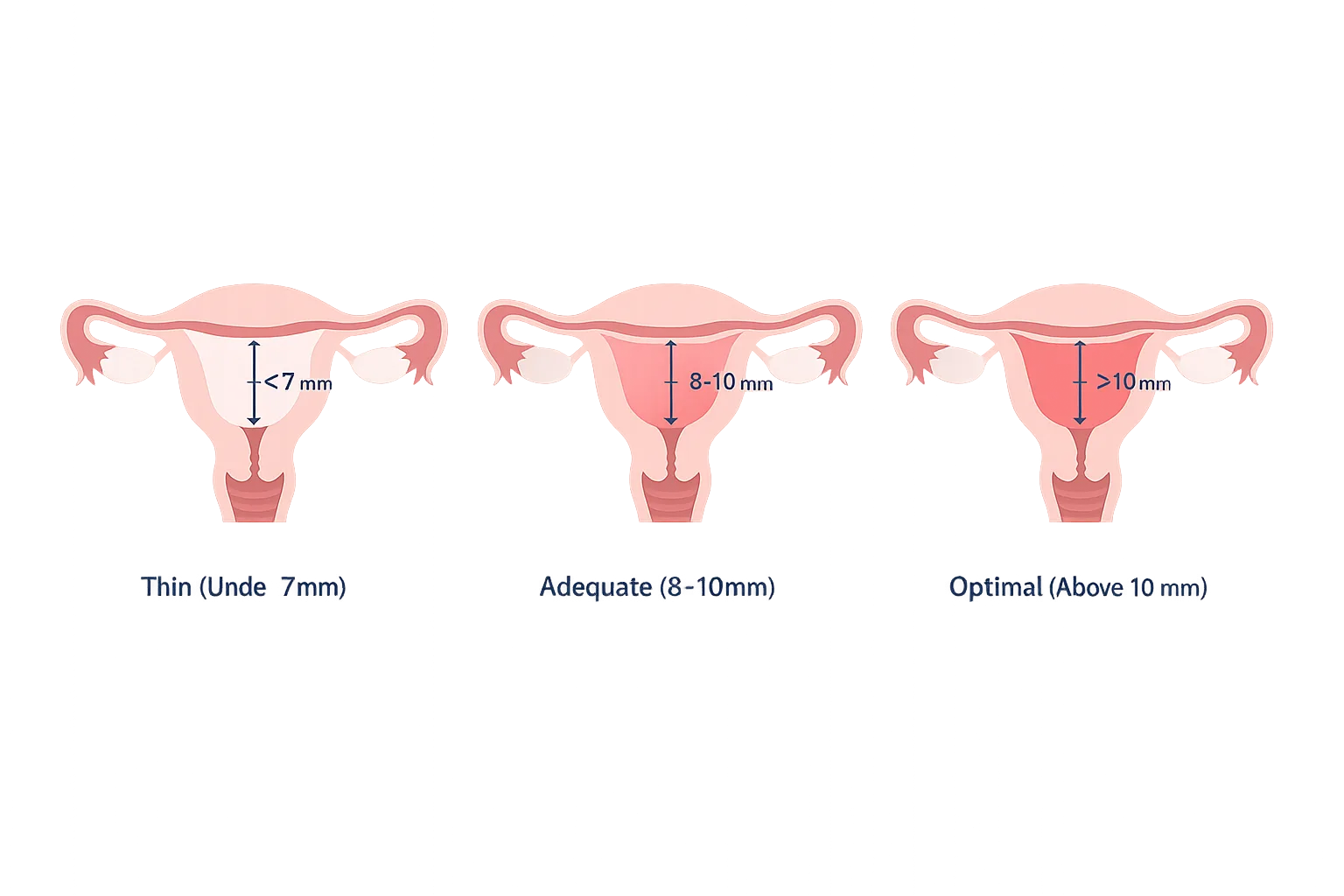
The endometrium is the lining of the uterus, and it is the tissue an embryo implants into. It thickens through the menstrual cycle in response to oestrogen, and for implantation to succeed it needs to be adequately developed and receptive at the right moment. A lining that remains thin may reduce the chance of an embryo implanting, which is why thickness is monitored by ultrasound during IVF and before a frozen embryo transfer. Thickness alone is not the whole picture: pattern and blood flow matter too, and a lining slightly below a textbook figure does not necessarily prevent pregnancy. Where the endometrium is persistently thin, the useful step is to look for a reason, such as previous uterine surgery, adhesions, infection or inadequate oestrogen support, rather than simply repeating the same cycle unchanged.
Watch: Endometrial Thickness and Pregnancy..
Dr. Vani Sundarapandian explains this on the Jananam Fertility Centre channel.
How the lining is assessed
Endometrial thickness is measured by transvaginal ultrasound, usually in the days before ovulation or before a planned transfer. Alongside the measurement, the sonographer looks at the pattern of the lining and the blood flow to it.
Causes of a persistently thin lining
- Previous uterine surgery or curettage, sometimes with adhesions
- Chronic endometritis or previous infection
- Inadequate oestrogen exposure in a prepared cycle
- Reduced blood flow to the uterus
What can be done
Management depends on the cause. It may involve adjusting oestrogen support, treating infection or adhesions, changing the transfer protocol, or freezing embryos and transferring in a later, better-prepared cycle rather than proceeding with a fresh transfer.
Related: embryo transfer in IVF.
What should you know about a thin uterine lining?
How thick should the endometrium be?
During IVF and before a frozen transfer, a lining above roughly 8 mm is generally looked for. A lining slightly below a textbook figure does not necessarily prevent pregnancy, which is why the number is interpreted alongside pattern and blood flow.
Why is thickness not the whole picture?
Because pattern and blood flow matter too. A lining of adequate thickness that is not receptive will not support implantation, and a marginally thinner lining with a good pattern sometimes will. The measurement is one input, not a verdict.
What causes a persistently thin lining?
Previous uterine surgery, adhesions, infection, or inadequate oestrogen support are the common explanations. Where the endometrium is repeatedly thin, the useful step is to look for the reason rather than simply repeating the same cycle unchanged.
Can a thin lining be treated?
Often the approach is to treat the underlying cause: releasing adhesions, treating infection, or adjusting oestrogen support. Success depends on what is found, which is why investigation comes before repeating a transfer.
When is the lining measured?
By ultrasound during the stimulation cycle and again before a frozen embryo transfer, typically around ten days after oestrogen is started. Measurement is timed to the point at which a transfer decision has to be made.
Should a transfer be cancelled if the lining is thin?
Sometimes deferring and freezing the embryos is the better option, because the embryo can be transferred later into a better-prepared lining. Your doctor will weigh the specific measurement, the pattern, and how many embryos are available.
Does a thicker lining always mean a better chance?
No. Beyond an adequate thickness there is no benefit from being thicker, and an unusually thick lining can itself warrant investigation. Adequate and receptive matters more than maximal.
Can the lining be assessed outside a treatment cycle?
Yes. A scan during a natural cycle shows how the endometrium develops on its own, which can be useful where transfers have repeatedly failed.
Can anything be done to improve a thin lining?
The approach is to find and treat the cause rather than to treat the measurement. Adhesions can be released, infection treated, and oestrogen support adjusted. Where no reversible cause is found, options include deferring transfer and freezing embryos so the lining can be prepared differently in a later cycle. Repeating an identical cycle rarely produces a different result.
Clinical references
Independent clinical guidance relevant to this topic:
- NICE CG156 — Fertility problems: assessment and treatment
- ASRM — Practice Committee documents
- ESHRE — Guidelines and legal documents
This page summarises guidance discussed by Dr. Vani Sundarapandian, MD, DGO, MRCOG (UK), founder and Medical Director of Jananam Fertility Centre, Neelankarai, Chennai. It is general information and not a substitute for consultation.


