





- By: Jananam Fertility Centre
- September 11, 2026

Are twins more likely with IVF?
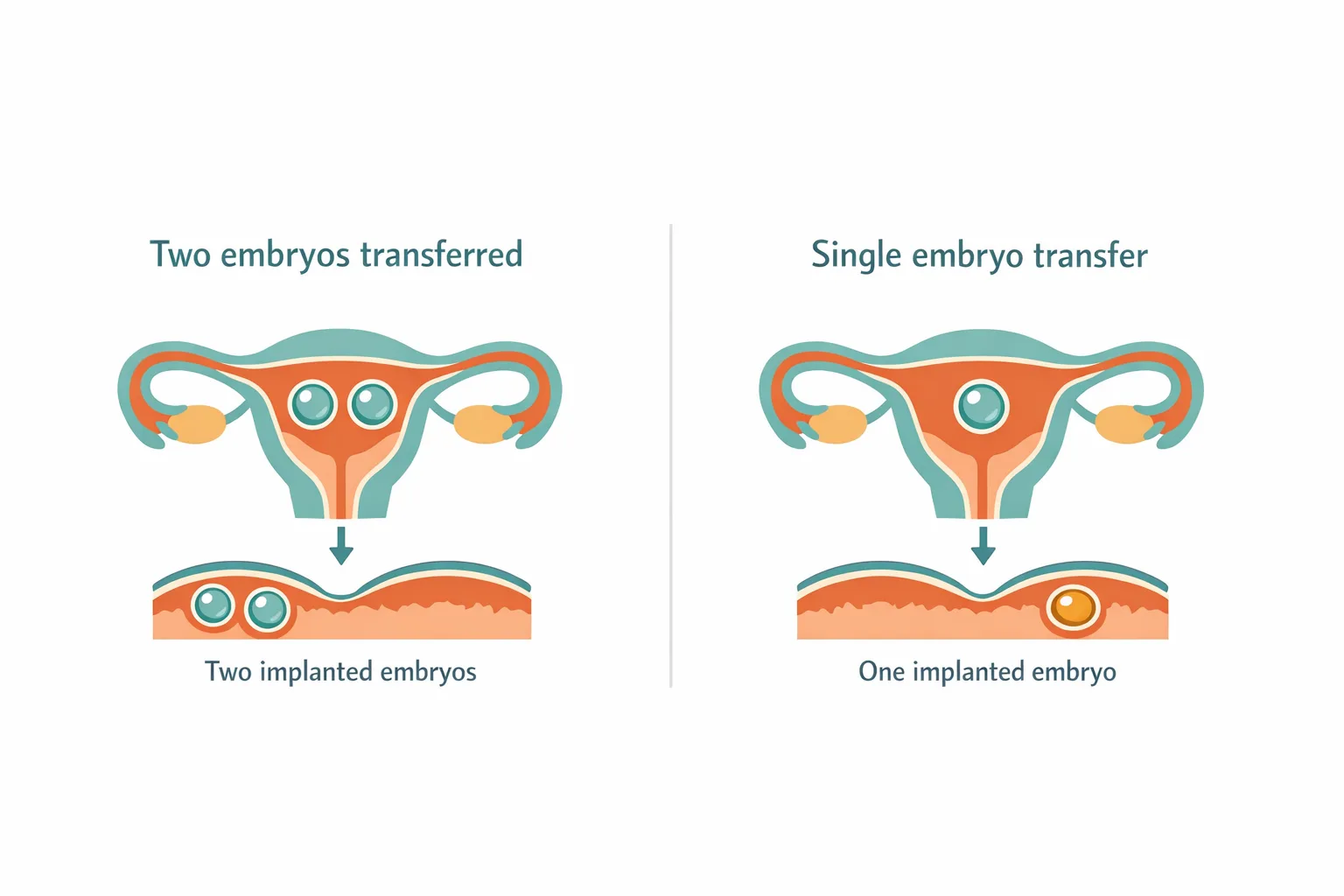
Yes, twin pregnancy is more common after IVF than after natural conception, and the main reason is straightforward: if more than one embryo is transferred, more than one can implant. Twins are sometimes seen as a welcome outcome, particularly by couples who have waited a long time, but a twin pregnancy is a higher-risk pregnancy for both mother and babies. It carries an increased chance of pre-eclampsia, gestational diabetes, anaemia, preterm delivery and low birth weight, and a higher likelihood of caesarean section and neonatal intensive care admission. For this reason the aim of modern IVF is a single healthy baby rather than the fastest possible pregnancy. Where embryo quality allows, transferring one embryo and freezing the remainder gives a comparable cumulative chance of a live birth with substantially lower risk.
Watch: Are there more chances of twins in IVF?
Dr. Vani Sundarapandian explains this on the Jananam Fertility Centre channel.
Why it happens
Transferring two embryos does not double the chance of pregnancy, but it does substantially raise the chance that both implant. Identical twinning can also occur, though far less commonly.
Risks of a twin pregnancy
- Preterm birth, the most common complication
- Low birth weight and neonatal intensive care admission
- Pre-eclampsia and gestational diabetes
- Anaemia and postpartum haemorrhage
- Higher rate of caesarean delivery
Single embryo transfer
Where a good-quality blastocyst is available, transferring one and freezing the rest allows further attempts from the same egg collection without repeating stimulation. Across a full course of treatment the chance of a live birth is comparable, and the risk profile is considerably better.
Related: embryo transfer in IVF and embryo freezing.
What are the risks of a twin pregnancy after IVF?
Why are twins more common after IVF?
Mainly because more than one embryo may be transferred, and more than one can implant. The likelihood follows directly from how many embryos are placed, which is why transfer policy is the main lever for controlling it.
Is a twin pregnancy riskier?
Yes, for both mother and babies. It carries an increased chance of pre-eclampsia, gestational diabetes, anaemia, preterm delivery and low birth weight, and a higher likelihood of caesarean section and neonatal intensive care admission.
Why transfer only one embryo?
Because the aim of modern IVF is a single healthy baby rather than the fastest possible pregnancy. Where embryo quality allows, transferring one and freezing the rest gives a comparable cumulative chance of a live birth with substantially lower risk.
Does single embryo transfer lower my chances?
Not when measured cumulatively across the transfers from one egg collection, including frozen ones. The chance per transfer may be lower, but the chance of eventually having a healthy baby is broadly comparable and the risks are lower.
Can identical twins still happen with one embryo?
Yes, though it is uncommon. A single embryo can split, producing identical twins. This is why a twin pregnancy cannot be entirely excluded even when only one embryo is transferred.
Who is most affected by twin pregnancy risk?
Risk rises with maternal age and with pre-existing conditions such as hypertension or diabetes. Your doctor will factor this in when discussing how many embryos to transfer, alongside embryo quality and your history.
Are twins more likely with IUI as well?
They can be, where ovulation induction produces more than one mature follicle. Monitoring exists partly to identify this and to advise accordingly before insemination proceeds.
Can a twin pregnancy be reduced to one?
Fetal reduction exists but is a difficult decision with its own risks. Avoiding the situation through single embryo transfer is considerably preferable to managing it later.
Is it ever reasonable to transfer two embryos?
Occasionally, and it is a decision made with your doctor rather than a default. It may be discussed where embryo quality is limited, where several transfers have not succeeded, and where you understand the risks a twin pregnancy carries for both mother and babies. Age and any pre-existing condition such as hypertension or diabetes weigh heavily in that conversation.
Clinical references
Independent clinical guidance relevant to this topic:
- HFEA — In vitro fertilisation (IVF)
- NICE CG156 — Fertility problems: assessment and treatment
- ACOG — Treating infertility
This page summarises guidance discussed by Dr. Vani Sundarapandian, MD, DGO, MRCOG (UK), founder and Medical Director of Jananam Fertility Centre, Neelankarai, Chennai. It is general information and not a substitute for consultation.


