





- By: Jananam Fertility Centre
- September 11, 2026

Why treat low sperm count if ICSI is planned anyway?
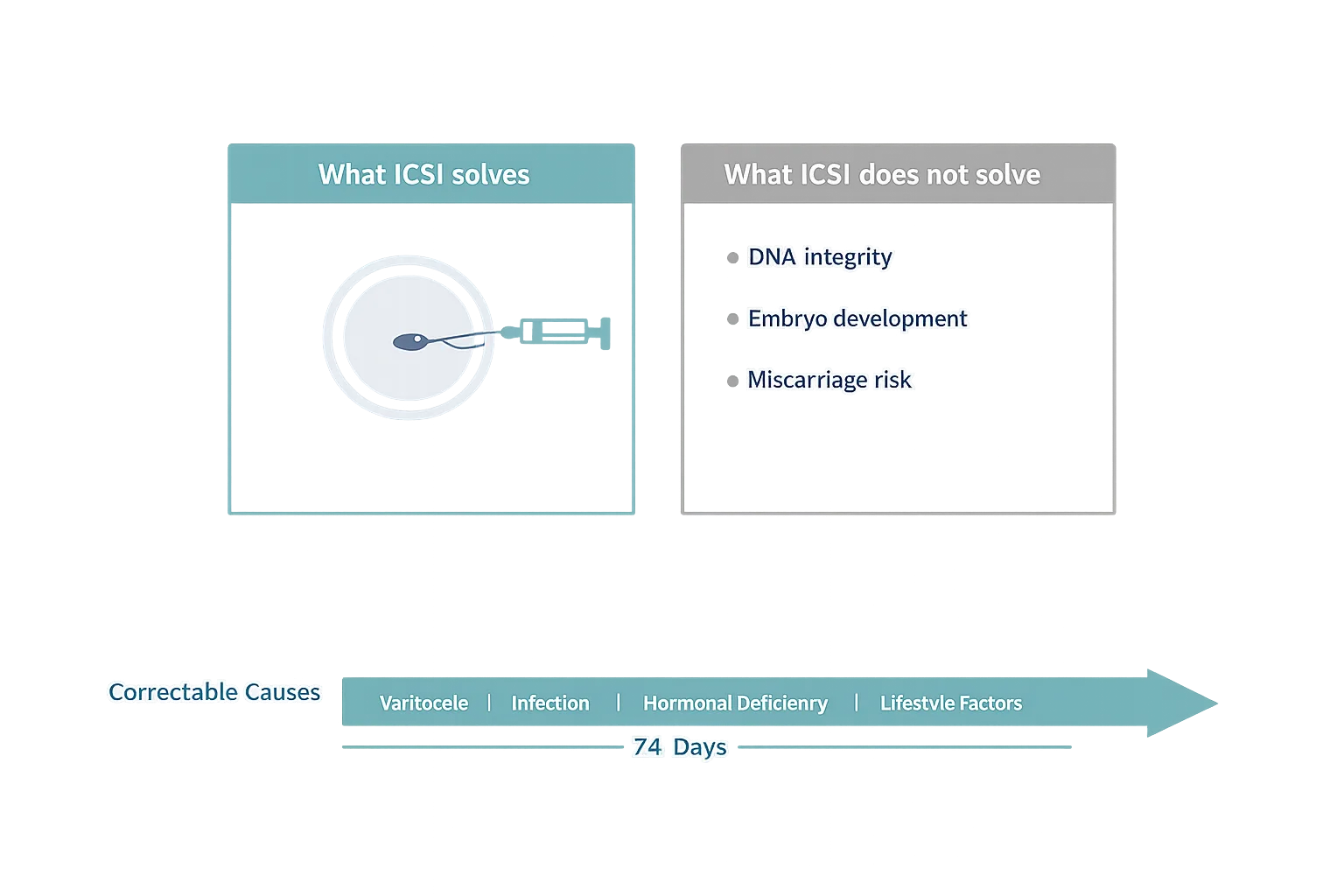
Because ICSI bypasses the difficulty of fertilisation but does not improve the sperm itself. In ICSI a single sperm is injected directly into the egg, so a very low count is no longer an obstacle to fertilisation. It does not follow that sperm quality stops mattering. The embryologist still has to select from what is available, and sperm DNA integrity influences fertilisation, embryo development and miscarriage risk. Some causes of a low count are correctable, including varicocele, infection, hormonal deficiency, uncontrolled diabetes or thyroid disease, certain medications, smoking, alcohol and heat exposure. Because sperm production takes roughly seventy-four days, addressing a correctable cause two to three months before a cycle can meaningfully change the sample available on the day. A low count is also occasionally the first sign of a condition worth diagnosing in its own right, independent of fertility.
Watch: Why We Treat Low Sperm Count Before ICSI | Dr. Vani Sundarapandian
Dr. Vani Sundarapandian explains this on the Jananam Fertility Centre channel.
What ICSI does and does not solve
ICSI solves the mechanical problem of getting a sperm into an egg. It does not select for DNA integrity, and it does not change the quality of the sample the embryologist has to work with.
Potentially correctable causes
- Varicocele
- Genital tract infection
- Hormonal deficiency
- Uncontrolled diabetes or thyroid disease
- Certain medications
- Smoking, alcohol, obesity and heat exposure
Why timing matters
Spermatogenesis takes about seventy-four days. Any intervention needs two to three months before the cycle to be reflected in the sample, which is why male assessment should happen early rather than in the weeks before egg collection.
Related: ICSI and PICSI at Jananam and surgical sperm retrieval.
Why does sperm quality still matter with ICSI?
If ICSI only needs one sperm, why does count matter?
Because ICSI solves fertilisation, not sperm quality. The embryologist still selects from what is available, and sperm DNA integrity influences fertilisation, embryo development and miscarriage risk.
Which causes of a low count can be treated?
Varicocele, infection, hormonal deficiency, uncontrolled diabetes or thyroid disease, certain medications, smoking, alcohol and heat exposure are all potentially correctable. Identifying which applies is the purpose of the assessment.
How long before a cycle should treatment start?
Sperm production takes roughly seventy-four days, so addressing a correctable cause two to three months before a cycle can meaningfully change the sample available on the day of collection.
Does sperm DNA fragmentation matter?
It can. DNA integrity affects embryo development and miscarriage risk even when the count itself looks acceptable, which is why testing is considered where there has been recurrent loss or repeated failed cycles.
Can a low sperm count signal something else?
Occasionally it is the first sign of a condition worth diagnosing in its own right, independent of fertility. That is one reason a male assessment is not treated as an afterthought.
Will lifestyle changes alone fix a low count?
Sometimes they help meaningfully, particularly where smoking, alcohol, weight or heat exposure are involved. Where there is a structural or hormonal cause, lifestyle change supports treatment rather than replacing it.
Is a single abnormal semen analysis enough to act on?
Usually not. Parameters vary considerably between samples, so an abnormal result is generally repeated after an interval before conclusions are drawn or treatment is planned.
Does a varicocele always need surgery?
No. Repair is considered where the varicocele is clinically significant and semen parameters are affected. Many are found incidentally and do not require intervention.
What tests should a man have before ICSI?
A semen analysis first, repeated after an interval because parameters vary between samples. Depending on the result, hormone testing, examination for varicocele, and sometimes genetic testing or sperm DNA fragmentation testing follow. Where the count is very low or absent, further investigation is important because it occasionally identifies a condition worth diagnosing independently of fertility.
Does a low sperm count affect the child?
Sperm DNA integrity influences fertilisation, embryo development and miscarriage risk, which is why quality is addressed rather than relying on ICSI alone. Where a genetic cause for a very low count is suspected, testing and genetic counselling are offered, because some causes can be passed on. This is discussed before treatment rather than afterwards.
Clinical references
Independent clinical guidance relevant to this topic:
- NICE CG156 — Fertility problems: assessment and treatment
- ACOG — Treating infertility
- NICHD — Infertility and fertility
This page summarises guidance discussed by Dr. Vani Sundarapandian, MD, DGO, MRCOG (UK), founder and Medical Director of Jananam Fertility Centre, Neelankarai, Chennai. It is general information and not a substitute for consultation.


