





- By: Jananam Fertility Centre
- June 15, 2026

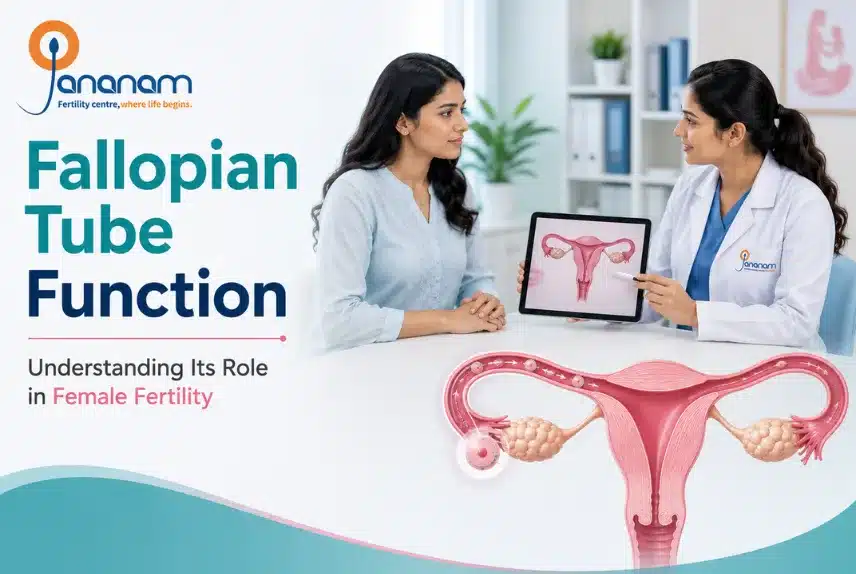
Fallopian Tube Function: Understanding Its Role in Female Fertility
The female reproductive system is a complex network where every organ plays an important role in conception. Among these organs, understanding the fallopian tube function is essential because it directly impacts fertility and pregnancy. Fallopian tubes are delicate structures that connect the ovaries to the uterus and create the pathway where fertilization usually occurs.
When the fallopian tubes work properly, sperm can travel to meet the egg and support the early stages of pregnancy. However, any damage or blockage may affect natural conception. Understanding how fallopian tubes function can help women recognize fertility concerns and seek the right medical care at the right time.
What Are Fallopian Tubes?
Fallopian tubes are thin, tube-like structures located on either side of the uterus. Each woman usually has two fallopian tubes that extend from the upper corners of the uterus toward the ovaries.
The tubes are lined with tiny hair-like structures called cilia. These cilia gently move the egg from the ovary toward the uterus. The health and movement of these structures are essential for successful fertilization and pregnancy.
What Is the Fallopian Tube Function?
The primary fallopian tube function is to transport the egg from the ovary to the uterus. However, its role goes beyond simple transportation.
The major functions include:
1. Capturing the Released Egg
During ovulation, the ovary releases an egg. Finger-like projections near the fallopian tube, called fimbriae, help collect the egg and guide it into the tube.
2. Supporting Fertilization
The fallopian tube is commonly the place where sperm meets the egg. Fertilization generally occurs inside the tube rather than inside the uterus.
3. Transporting the Fertilized Egg
After fertilization, the newly formed embryo slowly travels through the tube toward the uterus.
4. Providing a Suitable Environment
The fallopian tube creates a supportive environment with nutrients and fluids needed for embryo development during the early stages.
The entire fallopian tube function process is carefully coordinated and plays a vital role in reproductive health.
Why Is Fallopian Tube Health Important?
Healthy fallopian tubes are essential for a natural pregnancy. Even if ovulation occurs normally and sperm quality is good, damaged tubes can create challenges.
Some fertility issues linked to tube problems include:
- Difficulty conceiving naturally
- Increased risk of ectopic pregnancy
- Delayed fertilization
- Blocked movement of sperm or eggs
- Repeated pregnancy complications
Any issue affecting the normal fallopian tube function can reduce pregnancy chances.
Common Causes of Fallopian Tube Damage
Several factors can affect fallopian tube health.
Pelvic Inflammatory Disease (PID)
Infections in reproductive organs may cause inflammation and scarring.
Endometriosis
Tissue growth outside the uterus may create adhesions around the tubes.
Previous Abdominal Surgery
Surgical procedures can sometimes lead to scar tissue formation.
Sexually Transmitted Infections
Untreated infections may affect reproductive organs and cause damage to the tubes.
Tubal Pregnancy History
A previous ectopic pregnancy can increase the risk of tube complications.
Symptoms of Fallopian Tube Problems
Many women may not notice symptoms until they experience fertility difficulties.
Some possible signs include:
- Pelvic pain
- Pain during menstruation
- Unusual vaginal discharge
- Pain during intercourse
- Difficulty getting pregnant
- Irregular menstrual cycles
Because symptoms can be mild, regular reproductive health evaluation is important.
How Fallopian Tube Blockage Affects Fertility
Blocked fallopian tubes prevent eggs and sperm from meeting naturally. Depending on the blockage location, fertility can be partially or completely affected.
Common types include:
Proximal Blockage
Occurs near the uterus.
Distal Blockage
Occurs near the ovary.
Hydrosalpinx
A condition where fluid builds inside the tube and affects fertility.
Women diagnosed with a blockage may require fallopian tube blockage treatment based on the severity of the condition. Treatment options may include medication, minimally invasive surgery, or fertility procedures.
Diagnosis of Fallopian Tube Issues
Doctors use different methods to evaluate tube health.
Common diagnostic tests include:
Hysterosalpingography (HSG)
Uses X-rays and contrast dye to check tube openings.
Ultrasound Scan
Helps identify structural abnormalities.
Laparoscopy
Provides direct visualization of reproductive organs.
Early diagnosis allows fertility specialists to recommend suitable treatment approaches.
Treatment Options for Fallopian Tube Problems
Treatment depends on age, blockage type, and fertility goals.
Options include:
Medications
Used for infections and inflammation.
Surgical Repair
Some blockages can be corrected through minimally invasive surgery.
Assisted Reproductive Techniques
In severe cases, doctors may suggest fertility treatments.
For couples experiencing infertility, many clinics offering IVF treatment in Chennai provide advanced reproductive solutions for better pregnancy outcomes.
When IVF Becomes an Option
If fallopian tubes are severely damaged or blocked, IVF may become a recommended treatment.
During IVF:
- Eggs are collected from the ovaries
- Fertilization occurs in the laboratory
- The embryo is transferred directly into the uterus
Since IVF bypasses the fallopian tubes completely, it may help couples facing tubal infertility.
Several couples compare the IVF treatment cost in Chennai before choosing a fertility center. Costs may vary depending on medical requirements, procedures, and treatment plans.
Advantages of IVF for Tubal Ligation
There are several advantages of IVF for women with severe fallopian tube problems.
Benefits include:
- Bypasses blocked tubes
- Higher pregnancy chances in certain cases
- Controlled fertilization process
- Embryo monitoring before transfer
- Suitable for multiple fertility conditions
Women often consult the Best IVF doctor in Chennai to understand personalized fertility options and determine the right treatment path.
Choosing the Right Fertility Support
Fertility concerns can feel overwhelming, but early guidance and proper diagnosis can make a significant difference. A specialist can evaluate reproductive health and recommend individualized treatment plans based on age, medical history, and fertility goals.
What are the parts of the fallopian tube?
Each fallopian tube is roughly 10 to 12 centimetres long and is described in four named sections, running from the ovary toward the uterus. The distinctions matter clinically, because blockage in different sections is treated differently and carries a different outlook.
- Infundibulum — the funnel-shaped outer end that opens toward the ovary
- Fimbriae — finger-like projections at the infundibulum that sweep across the ovary and capture the released egg
- Ampulla — the widest section, and where fertilisation normally takes place
- Isthmus — the narrow segment closest to the uterus, which controls the passage of the embryo into the uterine cavity
The tube is not a passive pipe. Its wall contains smooth muscle that contracts rhythmically, and its lining is covered in cilia, microscopic hair-like structures that beat in a coordinated direction. Together these produce the peristaltic movement that carries the egg inward and, at the same time, helps sperm travel outward toward it.
How does the fallopian tube move the egg?
At ovulation the fimbriae sweep across the surface of the ovary and draw the released egg into the infundibulum. There is no direct physical connection between ovary and tube, which is why the fimbriae matter: damage to them can prevent egg pickup even when the rest of the tube is open.
The egg is then moved along by ciliary beating and muscular contraction toward the ampulla, where it may meet sperm. After fertilisation, the developing embryo continues toward the uterus over about five days, dividing as it travels and reaching the blastocyst stage by the time it arrives.
Because the journey depends on both cilia and muscle, a tube that is anatomically open can still function poorly. Infection or inflammation can destroy cilia while leaving the channel patent, which is one reason a normal tubal patency test does not guarantee normal tubal function.
How is tubal patency tested?
Tubal patency means whether the tubes are open. It is assessed in one of three ways, chosen according to what else is being looked for:
- Hysterosalpingogram (HSG) — X-ray imaging with contrast passed through the cervix, showing the shape of the cavity and whether dye spills from each tube
- HyCoSy or HyFoSy — ultrasound-based alternatives using a contrast medium, avoiding radiation
- Laparoscopy with dye — direct visualisation under anaesthesia, which also identifies endometriosis and adhesions that imaging cannot show
Where a tube is blocked and filled with fluid, a condition called hydrosalpinx, that fluid can leak into the uterus and reduce the chance of an embryo implanting. In that situation removal or clipping of the affected tube, a salpingectomy, is often advised before IVF rather than after an unsuccessful transfer.
FAQs About Fallopian Tube Function
1. What is the main fallopian tube function?
The main function of the fallopian tube is to transport the egg from the ovary to the uterus and to support fertilization.
2. Can a woman get pregnant with one fallopian tube?
Yes. Pregnancy is possible with one healthy and functioning fallopian tube.
3. What causes blocked fallopian tubes?
Common causes include infections, endometriosis, pelvic inflammatory disease, and scar tissue.
4. Is fallopian tube blockage painful?
Some women experience pelvic pain, while others may not notice symptoms.
5. How is fallopian tube blockage diagnosed?
Doctors often use HSG tests, ultrasound scans, or laparoscopy.
6. What is fallopian tube blockage treatment?
Treatment may involve medication, surgery, or assisted reproductive procedures, depending on the blockage severity.
7. Can IVF help if both tubes are blocked?
Yes. IVF bypasses the tubes and can improve pregnancy chances.
8. What are the advantages of IVF for infertility?
The advantages of IVF include bypassing tube problems and increasing conception opportunities.
9. How much is IVF treatment cost in Chennai?
The IVF treatment cost in Chennai varies based on procedures, fertility conditions, and clinic services.
10. Who is considered the Best IVF doctor in Chennai?
The Best IVF doctor in Chennai depends on experience, success rates, patient care, and treatment expertise.

Conclusion
Understanding fallopian tube function is essential for recognizing how fertility works and identifying potential reproductive concerns. Healthy tubes play a major role in conception by supporting egg transport and fertilization. When problems occur, early diagnosis and proper treatment can improve outcomes. Modern fertility treatments and IVF solutions provide hope for couples seeking successful parenthood journeys.
Clinical references
Independent clinical guidance relevant to this topic:
- NICE CG156 — Fertility problems: assessment and treatment
- ACOG — Treating infertility
- NICHD — Infertility and fertility
What is the role of the fallopian tube in the female reproductive system?
It is where egg and sperm meet. The fallopian tube captures the egg released at ovulation, provides the site where fertilisation occurs, and transports the resulting embryo to the uterus. It is the only route between ovary and uterus, which is why tubal damage is a direct cause of infertility.
What happens if only one fallopian tube works?
Pregnancy is still possible. The remaining tube can often capture an egg released from either ovary, because the fimbriae are mobile. The monthly chance is reduced rather than removed, and many women conceive naturally with one functioning tube.
Can a blocked fallopian tube be unblocked?
Sometimes, depending on where and why it is blocked. A blockage near the uterus may be treatable by cannulation, while extensive damage further along is generally not repairable. Where repair is unlikely to work, IVF bypasses the tubes entirely.
Does a normal HSG mean my tubes are working properly?
Not entirely. An HSG shows whether the tubes are open, not whether the cilia and muscular movement are working. Infection can destroy the cilia while leaving the channel patent, so a normal result reduces but does not eliminate a tubal factor.
Why does tubal damage cause ectopic pregnancy?
Because a damaged tube can still allow sperm through but fail to transport the embryo onward. The embryo then implants inside the tube rather than the uterus. This is why a history of tubal damage or previous ectopic pregnancy warrants early scanning in a subsequent pregnancy.


