





- By: Jananam Fertility Centre
- September 11, 2026

What is the best age to get pregnant?
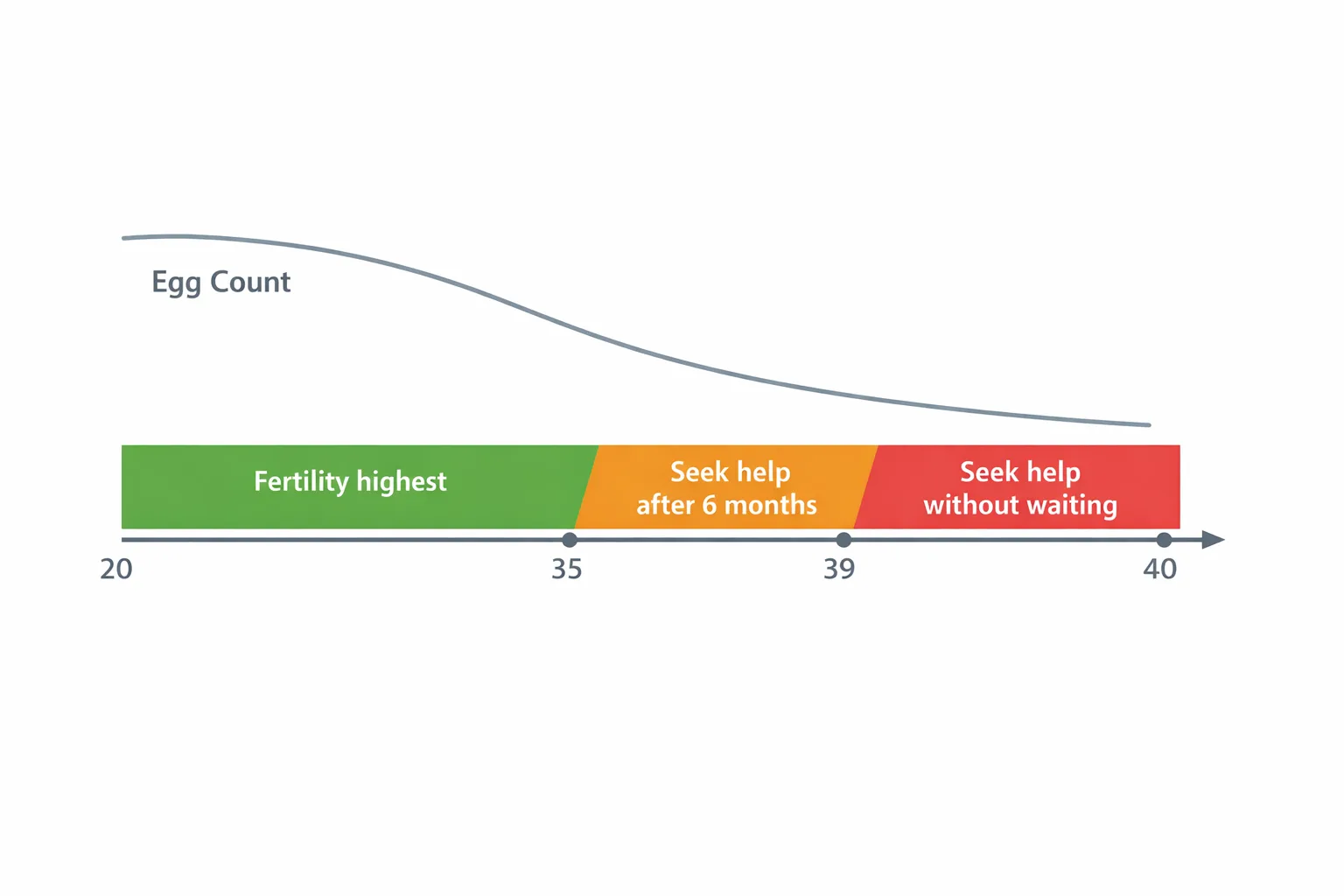
Fertility is highest in the twenties and early thirties, and declines gradually from the mid-thirties as both the number and the quality of eggs reduce. There is no single correct age to conceive, but age does change how long it is sensible to keep trying before seeking help. As a general rule, a woman under 35 with regular cycles and no known fertility problem can try naturally for about a year before requesting an evaluation. From 35 onwards that window shortens to around six months, because the same delay costs more in terms of declining ovarian reserve. Women over 40, or anyone with irregular periods, known endometriosis, previous pelvic surgery or a partner with a known semen abnormality, should seek assessment without waiting. Earlier evaluation does not commit anyone to treatment. It establishes what is happening while more options remain open.
Watch: Which is the best age to get pregnant? – Dr Vani Sundarapandian
Dr. Vani Sundarapandian explains this on the Jananam Fertility Centre channel.
How age affects fertility
A woman is born with her full complement of eggs, and that number falls steadily throughout life. Egg quality declines alongside quantity, which is why the chance of conceiving in any given month reduces with age and the risk of miscarriage rises.
Male fertility also changes with age, though more gradually. Sperm quality and DNA integrity can decline from the forties onwards.
When should you seek an evaluation?
- Under 35 — after about 12 months of regular unprotected intercourse without conception
- 35 to 39 — after about 6 months
- 40 and over — without waiting
- At any age — if periods are irregular or absent, there is known endometriosis or PCOS, previous pelvic surgery or infection, or a known male-factor problem
What an evaluation involves
An initial assessment is straightforward: a discussion of history and cycles, ovarian reserve testing, an ultrasound, and a semen analysis for the male partner. These establish whether there is a treatable cause and whether time is a factor.
Related reading: deciding when to move from natural attempts to IVF and IVF treatment at Jananam Fertility Centre.
How does age change your fertility options?
When is fertility at its highest?
In the twenties and early thirties. Fertility declines gradually from the mid-thirties as both the number and the quality of eggs reduce, and that decline accelerates through the late thirties and forties.
Is there a single best age to have a baby?
No. There is no single correct age to conceive, and the decision involves far more than biology. What age does change is how long it is sensible to keep trying before asking for an evaluation.
How long should I try at my age?
Under 35 with regular cycles and no known problem, about a year. From 35 onwards, around six months, because the same delay costs more in declining ovarian reserve. Over 40, seek assessment without waiting.
Does a regular cycle mean my fertility is fine?
Not necessarily. Regular cycles suggest ovulation is happening but say nothing about egg quality, tubal patency or semen parameters. Age-related decline in egg quality occurs while cycles remain perfectly regular.
What if I am not ready to have a child yet?
Egg freezing preserves eggs at your current age and is worth discussing, particularly from the mid-thirties. It does not stop your natural fertility changing, but it keeps the stored eggs at the age they were collected.
Does male age matter?
Yes, though the change is more gradual. Semen parameters and sperm DNA integrity alter with age, and paternal age is associated with a modest increase in some risks. Both partners are worth assessing rather than only the woman.
Does egg freezing change the age equation?
It preserves eggs at the age they were collected, which is why the age at freezing matters more than the age at use. It does not slow your natural decline in fertility.
Is there a point at which IVF is no longer advisable?
There is no fixed age, but as ovarian reserve falls the realistic chance declines and donor eggs may be discussed. An honest clinic will say when the prospect has become low.
Clinical references
Independent clinical guidance relevant to this topic:
- WHO — Infertility fact sheet
- NICE CG156 — Fertility problems: assessment and treatment
- ACOG — Treating infertility
This page summarises guidance discussed by Dr. Vani Sundarapandian, MD, DGO, MRCOG (UK), founder and Medical Director of Jananam Fertility Centre, Neelankarai, Chennai. It is general information and not a substitute for consultation.


