





- By: Jananam Fertility Centre
- August 13, 2026

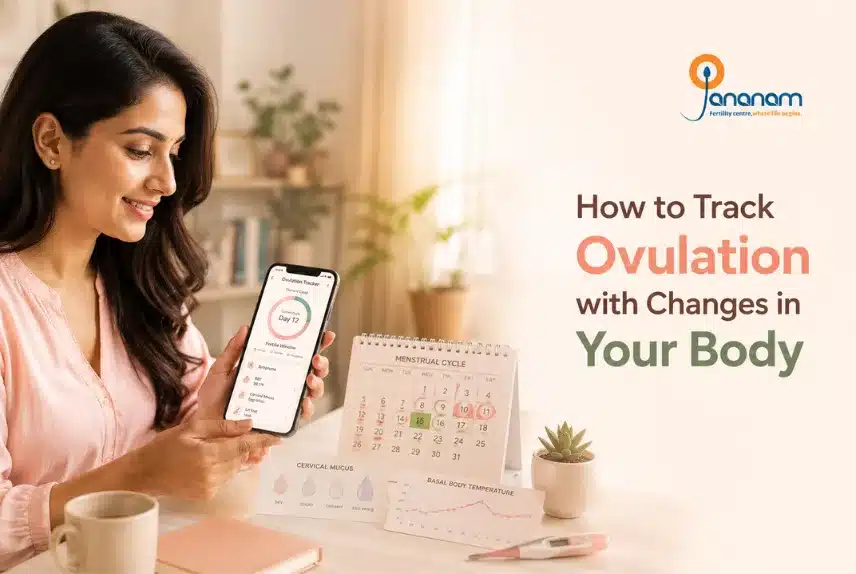
How to Track Ovulation with Changes in Your Body
Knowing when ovulation occurs can be helpful for couples who are trying to conceive. Ovulation is the stage of the menstrual cycle when an ovary releases an egg. Since the egg remains available for fertilisation for a relatively short period, identifying the fertile window can help couples better understand when pregnancy is most likely.
The good news is that your body may provide several natural clues around ovulation. Changes in cervical mucus, basal body temperature, menstrual-cycle patterns, and hormone levels can all provide useful information.
If you are wondering how to track ovulation, the best approach is to understand several signs rather than depending on one symptom alone. For people with irregular cycles or suspected ovulation problems, medical evaluation may be more useful than home tracking alone.
What Is Ovulation?
Ovulation occurs when a mature egg is released from an ovary. Hormonal changes during the menstrual cycle prepare the follicle and eventually trigger the release of the egg.
Ovulation does not necessarily happen on the same calendar day for everyone. It can vary between individuals and even from one menstrual cycle to another.
For many people, ovulation occurs approximately 14 days before the next menstrual period rather than necessarily on “day 14” of the cycle. This is why simply counting from the first day of your period may not accurately predict ovulation in every cycle.
Why Is Tracking Ovulation Important?
Tracking ovulation can help you:
- Understand your menstrual cycle
- Identify your fertile window
- Time intercourse when trying to conceive
- Recognise changes in your normal cycle
- Identify possible irregular ovulation
- Discuss fertility concerns more clearly with a doctor
The fertile period extends beyond the exact day of ovulation because sperm can survive in the female reproductive tract for several days, while the egg remains fertilisable for roughly 12–24 hours after release. Having intercourse in the days leading up to ovulation can therefore be important when trying to conceive.
How to Track Ovulation Naturally
There is no single method that works perfectly for everyone. Combining cycle tracking with physical signs and, when appropriate, ovulation tests can provide a clearer picture.
1. Track Your Menstrual Cycle
The simplest starting point is recording the first day of every period.
Day 1 is the first day of menstrual bleeding. Continue recording the beginning of each subsequent period to determine your cycle length.
For example, if your period starts on January 1 and the next period begins on January 29, your cycle length is 28 days.
However, cycle length alone should not be used to determine ovulation because the timing can vary. Tracking several cycles can help you identify your personal pattern.
You can use:
- A traditional calendar
- A fertility tracking app
- A period tracking app
- A digital fertility tracker
- A simple notebook or spreadsheet
Modern fertility apps can make recording easier, but their predictions should be viewed as estimates rather than proof that ovulation has occurred.
2. Observe Changes in Cervical Mucus
One of the most noticeable body changes around ovulation is cervical mucus.
As ovulation approaches, hormonal changes can cause cervical mucus to become:
- Clear
- Thin
- Wet
- Slippery
- Stretchy
Many people compare fertile cervical mucus to the consistency of raw egg white.
After ovulation, cervical mucus generally becomes thicker, cloudier or less noticeable.
This change can be a useful natural indicator of the fertile period. However, vaginal infections, certain medications, hormonal contraception and other factors can alter discharge, so unusual discharge should not automatically be interpreted as an ovulation sign.
3. Monitor Basal Body Temperature
Basal body temperature (BBT) is your body’s resting temperature.
To monitor it, take your temperature every morning before getting out of bed, ideally around the same time each day, and record the result.
After ovulation, progesterone can cause a small increase in basal body temperature.
The important point is that BBT is generally more useful for confirming that ovulation may have occurred than for predicting it in advance. ACOG notes that temperature charting can confirm ovulation but cannot reliably predict it.
Factors such as:
- Poor sleep
- Fever
- Alcohol
- Travel
- Different waking times
- Stress
may affect temperature readings.
Therefore, look for a pattern across several days rather than focusing on a single reading.
4. Use an Ovulation Predictor Kit
Ovulation predictor kits, commonly called OPKs, are available for home use.
These urine tests detect a rise in luteinising hormone (LH), which occurs before ovulation. A positive result can indicate that ovulation may be approaching.
OPKs can be particularly useful for people who want a more objective indication of their fertile period.
However, a positive LH test does not guarantee that ovulation has actually occurred in every situation. People with certain hormonal conditions, including some individuals with PCOS, may experience patterns that make interpretation more difficult.
If you repeatedly get confusing results, speaking with a fertility specialist can help.
5. Pay Attention to Other Body Changes
Some people notice additional physical changes around ovulation.
These may include:
- Mild lower abdominal discomfort
- Increased sexual desire
- Breast tenderness
- Bloating
- Mood changes
- Increased energy
- Changes in cervical mucus
Not everyone experiences these symptoms, and they are not reliable indicators on their own.
For this reason, they are best considered alongside menstrual-cycle tracking and other fertility signs.
How to Track Ovulation More Accurately
If you want to improve your understanding of your cycle, consider combining methods.
A simple tracking routine could include:
Step 1: Record the first day of your period.
Step 2: Record your cycle length.
Step 3: Observe cervical mucus every day.
Step 4: Track your basal body temperature consistently if appropriate.
Step 5: Consider an ovulation predictor kit around the expected fertile period.
Step 6: Record unusual symptoms or cycle changes.
Step 7: Review the pattern over several menstrual cycles.
Using multiple fertility indicators can provide more useful information than relying on one symptom alone. NHS guidance similarly recommends tracking multiple fertility indicators, including temperature, vaginal discharge and menstrual-cycle information.
What If You Have Irregular Periods?
Tracking ovulation can be more challenging when periods are irregular.
Irregular cycles may be associated with several factors, including hormonal changes, thyroid disorders, PCOS, significant changes in weight, stress and other reproductive-health conditions.
If your cycles frequently vary considerably, you may find that calendar-based ovulation predictions are less useful.
In such situations, a fertility specialist may recommend investigations such as hormone testing, ultrasound or other assessments depending on your symptoms and fertility history.
A progesterone blood test during the appropriate phase of the cycle can also be used clinically to help confirm whether ovulation has occurred.
Signs That May Suggest an Ovulation Problem
Understanding your usual cycle can help you recognise when something changes.
Possible signs that warrant discussion with a healthcare professional include:
- Very irregular periods
- Periods that frequently stop
- Very long or very short cycles
- No clear ovulation signs over repeated cycles
- Repeatedly negative ovulation tests despite long cycles
- Difficulty conceiving
- Symptoms associated with hormonal imbalance
An Ovulation Problem can affect the release of an egg and may contribute to difficulty conceiving. Importantly, fertility concerns can involve either partner, so evaluation should not automatically focus only on ovulation.
When Should You See a Fertility Specialist?
If you have been trying to conceive without success, it may be appropriate to discuss your situation with a fertility specialist.
You should consider seeking medical advice sooner if you have very irregular or absent periods, known reproductive-health conditions, or other concerns affecting fertility.
A fertility evaluation may involve reviewing your menstrual history, ovulation pattern and overall health. Depending on the situation, doctors may recommend blood tests, ultrasound or other fertility investigations.
For couples looking for fertility treatment in Chennai, choosing a centre that provides appropriate diagnostic evaluation can help determine whether the issue relates to ovulation, sperm health, the fallopian tubes, the uterus or other factors.
Can Ovulation Tracking Improve Your Chances of Pregnancy?
Tracking ovulation can help couples understand when they are most likely to be fertile and can support better timing of intercourse.
According to Mayo Clinic, having intercourse regularly during the days leading up to ovulation and around ovulation can improve the opportunity for conception.
However, tracking ovulation is only one part of fertility.
Age, egg and sperm health, fallopian-tube function, uterine factors and several other variables can influence the ability to conceive.
If pregnancy does not occur despite appropriately timed intercourse, professional fertility assessment may be beneficial.
Ovulation Tracking and Fertility Treatment
For some couples, home ovulation tracking may be sufficient. For others, particularly those with irregular cycles or an identified fertility issue, doctors may monitor follicle development more closely.
Follicle tracking through ultrasound can show the growth of ovarian follicles and help clinicians assess ovulation in appropriate situations.
Depending on the diagnosis, fertility treatment may range from ovulation-induction medicines and timed intercourse to IUI or IVF.
If you are researching the Best Fertility Centre in Chennai, look for a centre that offers proper fertility evaluation along with personalised treatment planning rather than choosing a clinic based only on advertisements or IVF packages.
Patients considering IVF may also compare factors such as doctor experience, embryology laboratory standards, available treatments, patient support, and transparency around IVF treatment cost in Chennai.
Similarly, people searching for the Best IVF doctor in Chennai should consider whether the doctor provides an individualised assessment and explains the recommended treatment clearly.
Choosing the Right Fertility Hospital
The right fertility centre should focus on identifying the underlying reason for difficulty conceiving instead of immediately recommending advanced treatment.
When comparing a Best fertility hospital in Chennai, consider:
- Fertility specialists and reproductive medicine expertise
- Diagnostic facilities
- Ultrasound and follicle-monitoring services
- Embryology laboratory capabilities
- Availability of IUI and IVF
- Male and female fertility evaluation
- Transparent treatment information
- Personalised counselling and follow-up
A good fertility-care pathway begins with understanding your individual situation.
Final Thoughts

Learning how to track ovulation can help you understand your body and identify your most fertile days. Changes in cervical mucus, menstrual-cycle patterns, basal body temperature, and LH levels can provide useful clues.
However, no single home-tracking method can diagnose every fertility problem. If your periods are irregular, you repeatedly cannot identify ovulation, or you have been trying to conceive without success, professional evaluation can help identify the underlying cause.
Whether you are beginning natural fertility tracking or considering fertility treatment in Chennai, understanding your menstrual cycle is a useful first step toward making informed reproductive-health decisions.
FAQs About How to Track Ovulation
1. How can I track ovulation at home?
You can track ovulation by recording your menstrual cycle, observing cervical mucus, monitoring basal body temperature and using an ovulation predictor kit. Combining multiple indicators can provide a clearer picture than relying on one sign.
2. What is the most common sign of ovulation?
A change in cervical mucus is one commonly observed sign. Around the fertile period, cervical mucus may become clearer, thinner, wetter and more slippery.
3. Can I track ovulation with a period app?
Yes. Period and fertility apps can help record cycle dates and estimate fertile days. However, app predictions are estimates and may be less accurate when cycles are irregular.
4. Does body temperature increase during ovulation?
Basal body temperature generally rises slightly after ovulation because of hormonal changes. BBT is more useful for confirming a pattern after ovulation than predicting the exact day beforehand.
5. How do ovulation predictor kits work?
Ovulation predictor kits detect a rise in luteinising hormone (LH) in urine. An LH surge usually occurs before ovulation and can help identify when ovulation may be approaching.
6. Can irregular periods affect ovulation tracking?
Yes. Irregular periods can make calendar-based predictions difficult. If your cycles are consistently irregular or you are concerned about an Ovulation Problem, a fertility specialist can evaluate the possible cause.
7. When should I see a fertility doctor?
Consider speaking with a fertility doctor if you have irregular or absent periods, persistent difficulty identifying ovulation, or difficulty conceiving. A doctor can recommend appropriate tests based on your individual circumstances.
8. Can ovulation tracking help with IVF treatment?
Ovulation tracking can provide useful information about the menstrual cycle, but IVF treatment uses medically controlled ovarian stimulation and monitoring. Your fertility specialist will determine the appropriate monitoring and treatment plan.
9. Is ovulation always on day 14?
No. The timing of ovulation varies between people and between cycles. Ovulation is often approximately 14 days before the next period rather than necessarily occurring on day 14.
10. Can fertility treatment help with ovulation problems?
Yes. Depending on the underlying cause, doctors may recommend treatments designed to support ovulation or other fertility treatments. The appropriate option depends on the individual’s diagnosis and fertility assessment.
Clinical references
Independent clinical guidance relevant to this topic:


