





- By: Jananam Fertility Centre
- September 11, 2026

How many IVF cycles does it take to get pregnant?
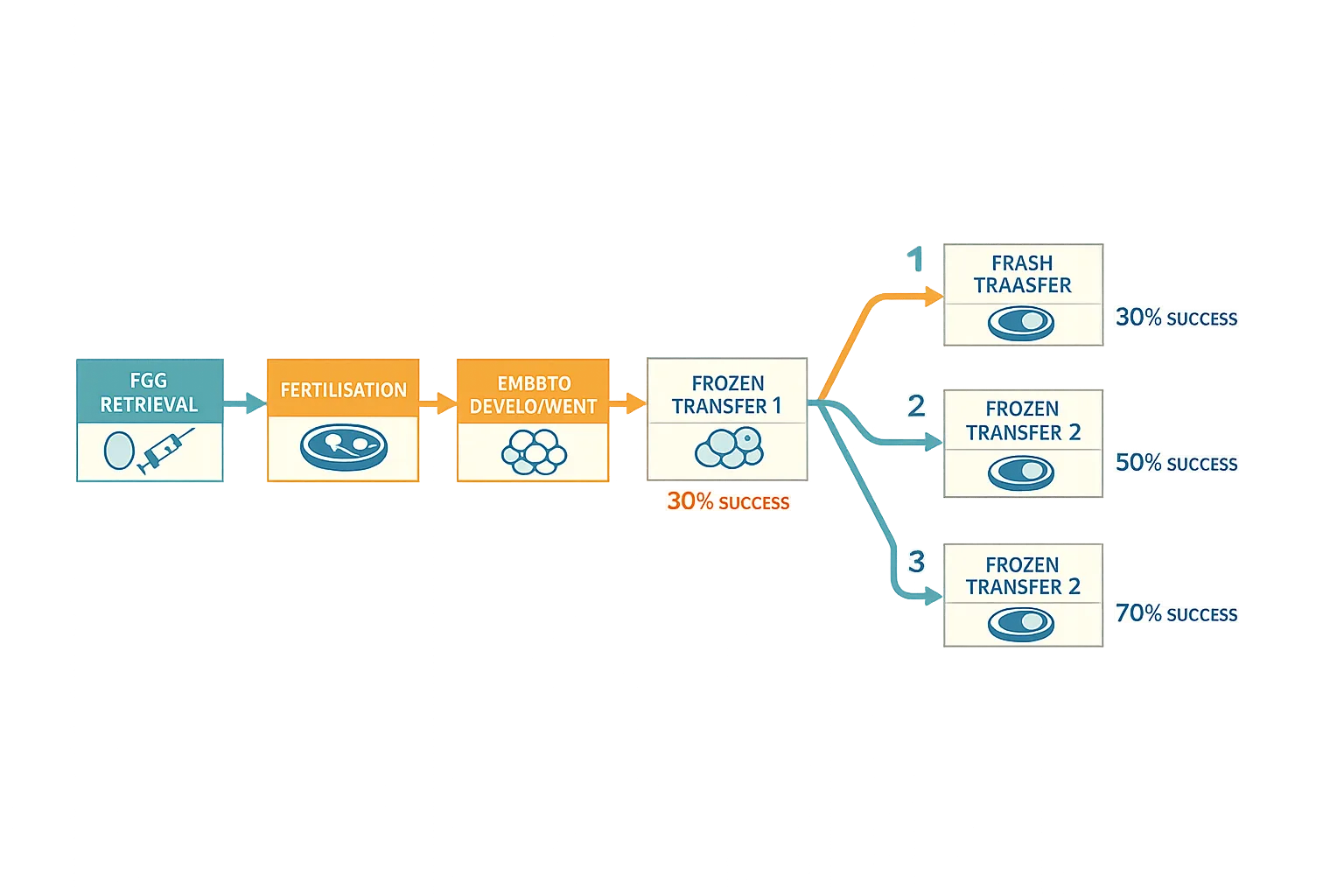
There is no fixed number. Some patients conceive after a single cycle and others need more than one, and the difference is driven by factors that are largely established before treatment starts: maternal age, ovarian reserve, the number and maturity of eggs collected, how many fertilise, and the quality of the embryos that develop. Because of this, outcomes are better understood cumulatively, across a course of treatment including any frozen embryo transfers from the same egg collection, rather than from one cycle in isolation. A single unsuccessful cycle is not usually a reason to conclude that IVF will not work. It is a reason to review what happened at each stage, because a cycle that produced good-quality embryos carries a different prognosis from one where few eggs were retrieved or none fertilised.
Watch: How Many IVF Cycles Does It Take to Get Pregnant
Dr. Vani Sundarapandian explains this on the Jananam Fertility Centre channel.
What influences the number of cycles
- Age — the strongest single predictor, through both egg number and egg quality
- Ovarian reserve — how many eggs are likely to be retrieved
- Fertilisation rate — how many mature eggs fertilise normally
- Embryo quality and development — whether embryos reach blastocyst stage
- Uterine factors — endometrial thickness, fibroids, adhesions
Why cumulative outcomes matter
One egg collection can produce several embryos. Where surplus embryos are frozen, subsequent transfers do not require another stimulation and retrieval. Assessing a course of treatment as a whole gives a more realistic picture than a single fresh transfer.
When to reassess
After an unsuccessful cycle the useful questions are how many eggs were collected and mature, how many fertilised, how the embryos developed, and what the transfer conditions were. Those answers determine whether to repeat the same protocol, change it, or consider a different approach.
Related: IVF at Jananam Fertility Centre and embryo freezing.
How should you judge progress across IVF cycles?
Why is there no fixed number of cycles?
Because outcome is driven by factors largely established before treatment starts: maternal age, ovarian reserve, how many eggs are collected and mature, how many fertilise, and the quality of the embryos that develop.
Why are cumulative outcomes the better measure?
Because a single egg collection can produce several transfers once frozen embryos are included. Judging treatment on one fresh cycle in isolation ignores the embryos still in storage from the same collection.
Does one failed cycle mean IVF will not work?
Usually not. It is a reason to review what happened at each stage. A cycle that produced good-quality embryos carries a very different prognosis from one where few eggs were retrieved or none fertilised.
What should be reviewed after an unsuccessful cycle?
Where the attrition happened: eggs retrieved and mature, fertilisation rate, embryo development and grade, and endometrial thickness. The answer determines whether the protocol, the laboratory approach or the transfer plan is what needs to change.
Should the protocol change after a failed cycle?
Only if the review points to a reason. Changing a protocol without a rationale rarely helps, whereas a specific finding, such as poor response or poor fertilisation, gives a clear direction for the next attempt.
How do I know when to stop?
That is a personal decision informed by medical reality: your age, ovarian reserve, and what previous cycles showed. An honest clinic will tell you when the realistic chance has become low rather than simply offering another cycle.
Does the chance improve with each successive cycle?
The chance in any single cycle stays broadly similar, but cumulative chance rises because each cycle is another opportunity. That is why outcomes are quoted across a course of treatment.
Should the protocol change after every failed cycle?
Only where the review points to a reason. Changing without a rationale rarely helps, whereas a specific finding gives a clear direction for the next attempt.
What happens to embryos we do not use?
Suitable embryos are frozen and stored for later transfers from the same egg collection, which is why cumulative outcomes matter. Storage, consent and the eventual disposition of embryos are governed in India by the ART (Regulation) Act 2021, and your clinic will explain the consent you are signing and what the options are at the end of the storage period.
Clinical references
Independent clinical guidance relevant to this topic:
- HFEA — In vitro fertilisation (IVF)
- NICE CG156 — Fertility problems: assessment and treatment
- ASRM — Practice Committee documents
This page summarises guidance discussed by Dr. Vani Sundarapandian, MD, DGO, MRCOG (UK), founder and Medical Director of Jananam Fertility Centre, Neelankarai, Chennai. It is general information and not a substitute for consultation.


