





- By: Jananam Fertility Centre
- September 11, 2026

How does natural conception happen?
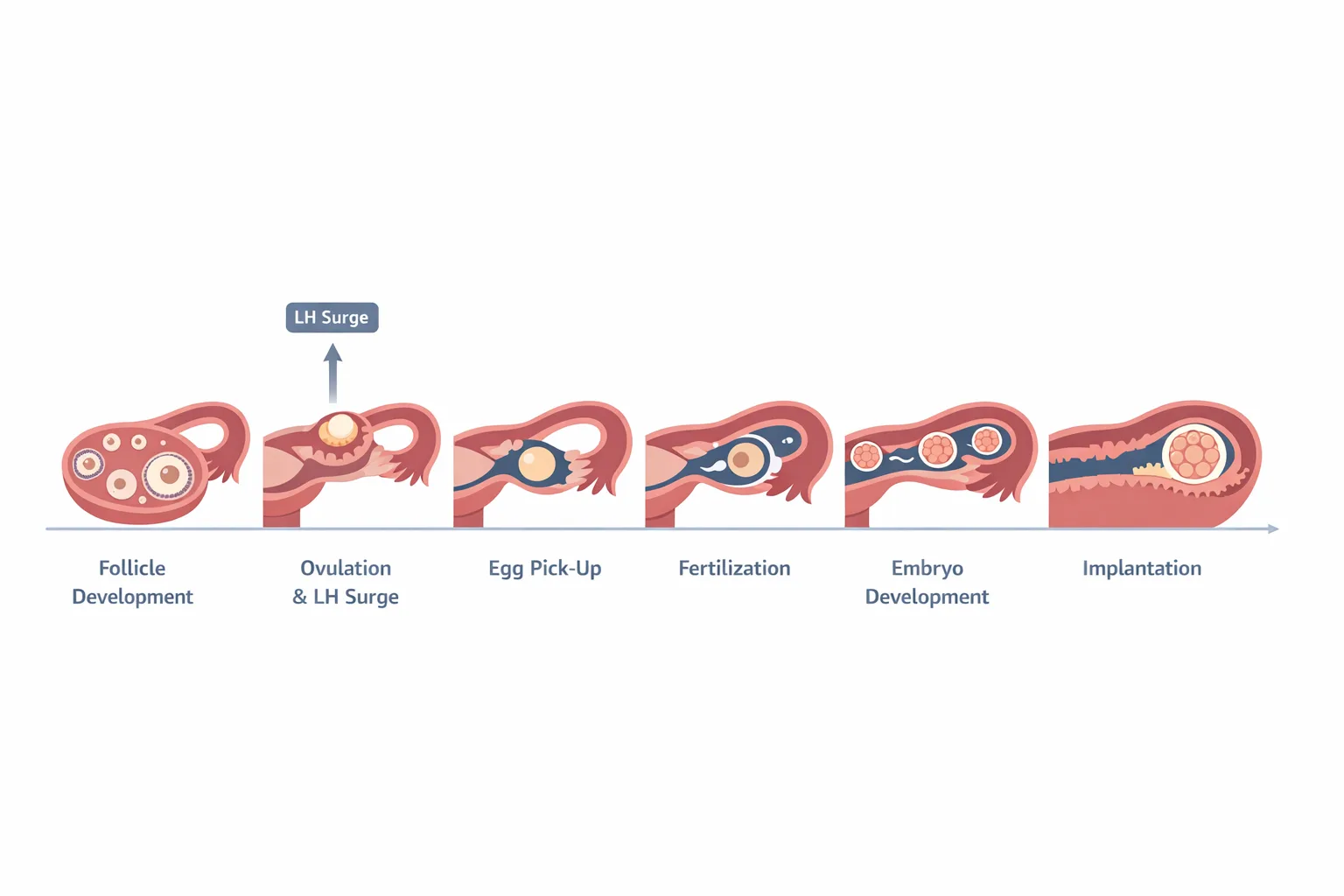
Natural conception depends on several steps happening in sequence within a narrow window each cycle. At the start of the cycle a group of follicles begins developing in the ovaries, and usually one becomes dominant. Around mid-cycle a surge of luteinising hormone triggers ovulation, releasing a mature egg which is picked up by the fallopian tube. The egg survives roughly twelve to twenty-four hours. Sperm deposited in the vagina travel through the cervix and uterus into the tube, where fertilisation normally takes place. The fertilised egg divides as it moves toward the uterus over about five days, reaching the blastocyst stage, and then implants into the endometrium. Each of these steps can fail independently, which is why investigating infertility means checking ovulation, tubal patency, uterine anatomy and semen quality rather than looking for a single cause.
Watch: How do natural pregnancy occur?
Dr. Vani Sundarapandian explains this on the Jananam Fertility Centre channel.
The sequence, step by step
- Follicle development — several follicles begin growing; one usually becomes dominant
- Ovulation — an LH surge releases the mature egg, about 14 days before the next period in a typical cycle
- Egg pick-up — the fimbriae of the fallopian tube collect the egg
- Fertilisation — normally in the outer third of the tube, within about 24 hours
- Embryo development — the embryo divides while travelling toward the uterus over roughly five days
- Implantation — the blastocyst embeds in the endometrium
Where the process can fail
- No ovulation, or irregular ovulation
- Blocked or damaged fallopian tubes
- Insufficient or poor-quality sperm
- A uterine lining that is not receptive
- Egg or embryo quality, which declines with age
Why this matters for investigation
Because the steps are independent, a fertility assessment checks each one: ovulation, tubal patency, uterine anatomy and semen parameters. A normal result in one does not rule out a problem in another.
Related: how age affects fertility, when to consult a fertility doctor and endometrial thickness and implantation.
How does conception actually happen, step by step?
How long does the egg survive after ovulation?
Roughly twelve to twenty-four hours. Sperm survive considerably longer in the reproductive tract, which is why the fertile window spans several days before ovulation rather than only the day of ovulation itself.
Where does fertilisation actually happen?
In the fallopian tube, not the uterus. The egg is picked up by the tube after ovulation and meets sperm there. This is precisely why tubal patency is checked when conception is not happening.
How long does implantation take?
The fertilised egg divides as it travels toward the uterus over about five days, reaching the blastocyst stage, and then implants into the endometrium. The whole sequence from ovulation to implantation takes roughly a week.
Why do I need tests if my cycles seem normal?
Each step can fail independently and silently. Investigation means checking ovulation, tubal patency, uterine anatomy and semen quality, because a regular cycle does not confirm that every stage of the process is working.
Does timing intercourse improve the chance?
Regular intercourse across the fertile window is generally more effective than trying to hit a single day. Rigid timing adds stress and can reduce frequency without improving the odds.
When should we seek help?
Under 35, after about a year of trying; from 35, after six months; over 40, without waiting. Earlier review makes sense if periods are irregular or there is known tubal, uterine or male-factor history.
How soon after ovulation can implantation be detected?
A blood test for hCG becomes reliable around two weeks after ovulation. Testing earlier frequently produces misleading results, which is why clinics specify a date rather than leaving it open.
Can conception happen outside the fertile window?
It is unlikely but not impossible, because sperm survive for several days and ovulation timing varies between cycles. This is why a single late ovulation can produce an unexpected result.
What stops conception when everything appears normal?
Standard tests examine ovulation, tubal patency, uterine anatomy and semen parameters, but they cannot directly observe egg quality, whether fertilisation occurs, or whether an embryo implants. A normal result set therefore means no detectable cause rather than no cause at all. This is why the diagnosis of unexplained infertility exists, and why treatment decisions rest on age and duration rather than on waiting for a test to reveal something.
Clinical references
Independent clinical guidance relevant to this topic:
This page summarises guidance discussed by Dr. Vani Sundarapandian, MD, DGO, MRCOG (UK), founder and Medical Director of Jananam Fertility Centre, Neelankarai, Chennai. It is general information and not a substitute for consultation.


